Revolutionizing Talent Acquisition: AI-Powered Resume Screening and Candidate Matching in Indonesia

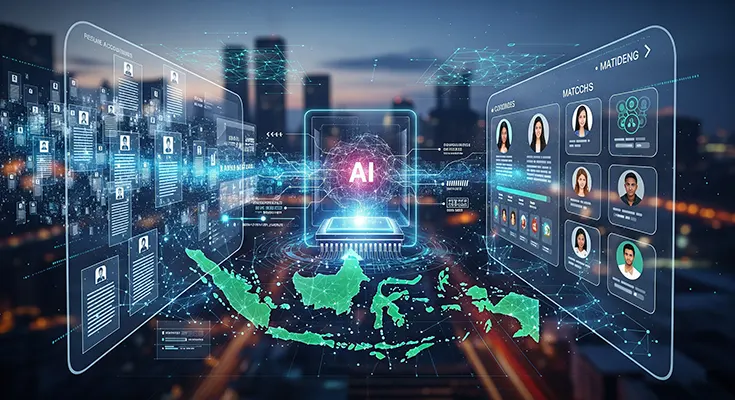
Revolutionizing Talent Acquisition: AI-Powered Resume Screening and Candidate Matching in Indonesia

In Indonesia’s dynamic job market, both companies and job seekers face a common challenge: a high volume of applications. For human resources (HR) professionals, sifting through hundreds, or even thousands, of resumes for a single opening is a tedious, time-consuming, and often subjective process. This is where AI-powered resume screening and candidate matching software has emerged as a game-changer, promising to transform talent acquisition.

These AI tools are not just a trend; they are becoming an essential part of modern recruitment strategies, enabling companies to find the best candidates faster and with greater objectivity.

How AI Changes the Game

Traditionally, resume screening relied on manual reviews or basic keyword searches within an Applicant Tracking System (ATS). If a resume didn’t contain the exact keywords from the job description, it could be overlooked, regardless of the candidate’s actual qualifications. AI takes this process to a new level by using advanced technologies.…

Revolutionizing Talent Acquisition: AI-Powered Resume Screening and Candidate Matching in Indonesia Read More

Countering Threats in the Digital Age: The Vital Role of AI in Cyber ​​Threat Detection and Analysis

Countering Threats in the Digital Age: The Vital Role of AI in Cyber ​​Threat Detection and Analysis

Amidst massive digital transformation, Indonesia’s cyber threat landscape is evolving at an unprecedented pace. Cyberattacks are now more sophisticated, automated, and designed to evade conventional defenses.1This is where AI tools for cybersecurity threat detection and analysis become vital. Artificial intelligence (AI) is no longer just an add-on feature, but a revolutionary vanguard in maintaining cybersecurity.

AI enables organizations to shift from a reactive security posture (responding to attacks after they occur) to a proactive one (predicting and preventing attacks before they occur). With the ability to process and analyze massive amounts of data, AI provides insights that human teams alone would never have been able to obtain.

Limitations of Conventional Cyber ​​Security

Before the widespread adoption of AI, cybersecurity teams face several significant challenges:

  1. Enormous Volume of Data: Modern security systems generate millions of logs and alerts every day. Manually analyzing this data is an impossible task and
Countering Threats in the Digital Age: The Vital Role of AI in Cyber ​​Threat Detection and Analysis Read More
Revolutionizing Research: AI Tools for Finding and Summarizing Complex Scientific Articles

Revolutionizing Research: AI Tools for Finding and Summarizing Complex Scientific Articles

In the fast-paced world of scientific research, a fundamental challenge remains the sheer volume of new information. For researchers, students, and academics, keeping up with the latest findings can be a daunting and time-consuming task. Traditional literature reviews require sifting through countless papers, a process that is often tedious and prone to human oversight.

AI-powered tools are now emerging as powerful allies, transforming the way researchers find, understand, and synthesize complex scientific articles. By leveraging machine learning, these tools can automate a significant portion of the research workflow, allowing users to move from information gathering to critical analysis with unprecedented speed and efficiency.

The Pain Points of Traditional Literature Review

The manual process of literature review is fraught with inefficiencies:

  • Information Overload: Scientific databases contain millions of papers, making it difficult to find truly relevant studies.
  • Time Consumption: Reading and summarizing lengthy, jargon-filled articles is a slow and mentally taxing
Revolutionizing Research: AI Tools for Finding and Summarizing Complex Scientific Articles Read More
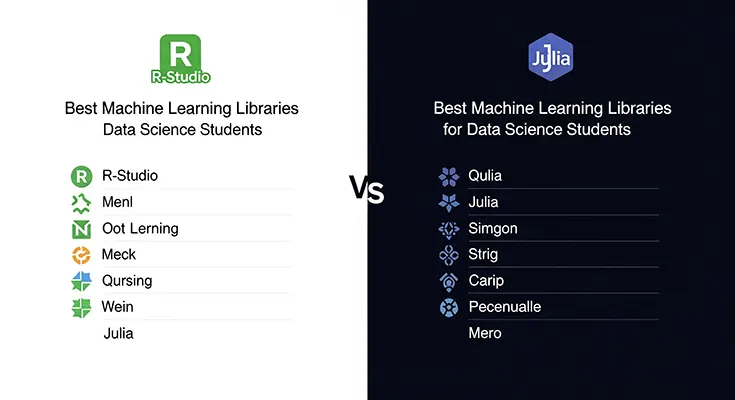
Best machine learning libraries for data science students using R and Julia.

Best machine learning libraries for data science students using R and Julia.

Machine Learning Libraries for R

R has a long-standing reputation as the language of choice for statisticians and academic researchers. Its vast ecosystem of packages makes it incredibly powerful for everything from statistical modeling to advanced data visualization. For machine learning, R provides a variety of mature and robust libraries.

  • Caret (Classification And REgression Training)

Caret is often the first stop for R users getting into machine learning. Think of it as a unified interface for over 200 different machine learning models. Instead of learning the specific syntax for each algorithm (like randomForest or xgboost), you can use a consistent set of functions to preprocess data, train models, tune hyperparameters, and evaluate performance. This makes it a fantastic learning tool, as it allows you to quickly compare different models without getting bogged down in implementation details.

  • tidymodels

For students who prefer a modern, consistent, and tidy approach to data science, …

Best machine learning libraries for data science students using R and Julia. Read More
Illuminating Insights: The Role of AI in Data Analysis and Visualization for Researchers in Indonesia

Illuminating Insights: The Role of AI in Data Analysis and Visualization for Researchers in Indonesia

In this era of massive information, researchers in Indonesia, from academics to industry practitioners, are faced with ever-increasing volumes of data. Transforming mountains of raw data into meaningful insights is key to innovation and informed decision-making. However, traditional data analysis and visualization processes are often time-consuming, require high technical expertise, and are prone to biased interpretation.

This is where AI-powered data analysis and visualization tools for researchers come in as a catalyst. These tools aren’t just helpful; they’re revolutionizing the way researchers in Indonesia interact with their data, enabling faster, deeper, and more understandable discoveries.

Challenges of Conventional Data Analysis for Researchers in Indonesia

Researchers, especially in Indonesia, often face several obstacles in processing data:

  1. Big Data: With the growth of data from sensors, social media, surveys, and government databases, managing and analyzing large data sets manually has become impossible.
  2. Technical Skills Gap: Not all researchers have a strong background
Illuminating Insights: The Role of AI in Data Analysis and Visualization for Researchers in Indonesia Read More