

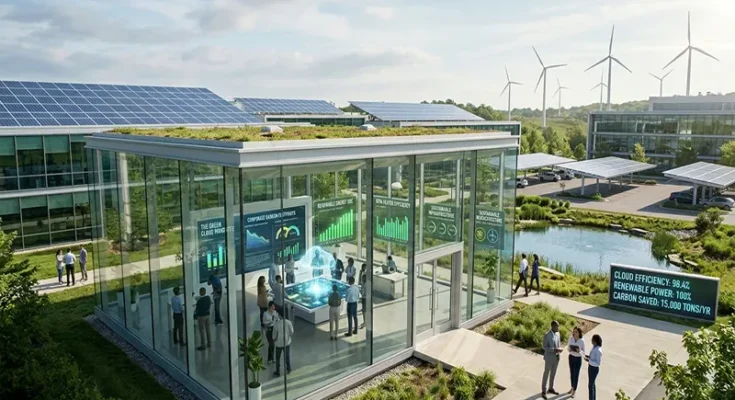
The Green Cloud Mandate: Reducing Corporate Carbon Footprints Through Sustainable Infrastructure

The Green Cloud Mandate: Reducing Corporate Carbon Footprints Through Sustainable Infrastructure

In 2026, the transition to the cloud is no longer just a driver of agility and cost-efficiency; it has become a core lever for corporate environmental, social, and governance (ESG) strategy. As digital operations expand, the “Green Cloud” has shifted from a sustainability buzzword to a board-level business requirement. While traditional on-premises data centers are often constrained by legacy hardware and inefficient cooling, hyperscale cloud environments offer a path to significantly lower carbon intensity per unit of compute.

The Four Pillars of Sustainable Cloud

Reducing IT-related carbon requires a multi-layered approach that moves beyond simple migration. Organizations are now focusing on four strategic pillars:

  • Energy Efficiency: Hyperscale data centers utilize advanced infrastructure, such as liquid cooling and AI-driven power management, to achieve a Power Usage Effectiveness (PUE) ratio approaching 1.0. By consolidating workloads into these optimized environments, companies benefit from economies of scale that are impossible to replicate in private
The Green Cloud Mandate: Reducing Corporate Carbon Footprints Through Sustainable Infrastructure Read More
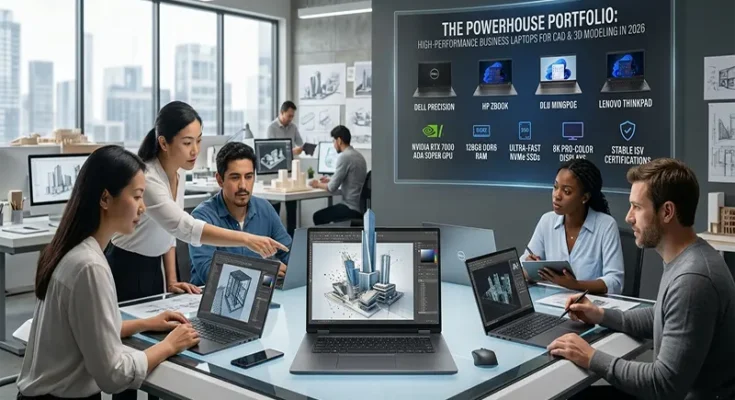
The Powerhouse Portfolio: High-Performance Business Laptops for CAD and 3D Modeling in 2026

The Powerhouse Portfolio: High-Performance Business Laptops for CAD and 3D Modeling in 2026

For architects, mechanical engineers, and 3D artists, the laptop is not merely a tool—it is the digital drafting table upon which complex projects are built. The leap from basic office computing to professional-grade CAD (Computer-Aided Design) and 3D modeling—using platforms like SolidWorks, AutoCAD, Revit, and Blender—requires a fundamental shift in hardware philosophy. In 2026, the “mobile workstation” has evolved into a powerhouse capable of handling massive geometry calculations and real-time ray tracing, all while remaining portable enough to move from the studio to the construction site.

The Hardware Hierarchy: Anatomy of a Workstation

A professional CAD laptop demands a specific synergy of components. Unlike consumer gaming machines, which prioritize raw frames per second, professional workstations prioritize stability, precision, and sustained throughput.

  • The GPU (Graphics Processing Unit): This is the heart of your modeling workflow. Professional-grade workstations utilize ISV-certified GPUs (Independent Software Vendor), such as the NVIDIA RTX Ada generation.
The Powerhouse Portfolio: High-Performance Business Laptops for CAD and 3D Modeling in 2026 Read More