
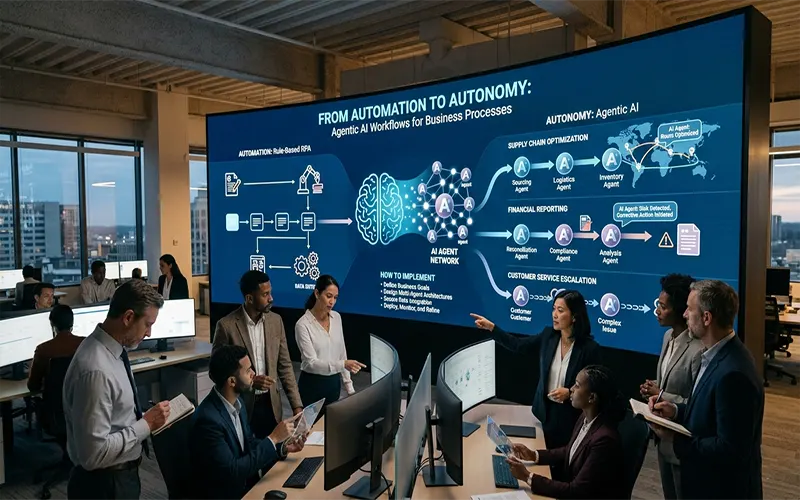
For years, businesses have relied on Robotic Process Automation (RPA) to handle repetitive, rule-based tasks. While effective for simple data entry, these tools are inherently brittle—they break if the process changes even slightly. The next frontier in digital transformation is Agentic AI. Unlike static automation, agentic systems are proactive, goal-oriented, and capable of reasoning through complex, multi-step workflows. By transitioning from rigid task-execution to autonomous goal-seeking, enterprises can finally unlock the true promise of intelligent operations.
The Core Architecture of Agentic Workflows
The shift to agentic systems requires moving away from the “if-this-then-that” logic of traditional automation toward a flexible, cognitive architecture. A robust agentic workflow is built on three foundational pillars:
- Planning and Reasoning: At the heart of an agent is a Large Language Model (LLM) that functions as a “brain.” When given a high-level goal, the agent decomposes it into manageable sub-tasks. It doesn’t just execute a script; it plans the sequence of events necessary to achieve the desired outcome.
- Tool Use and Orchestration: An agent is only as powerful as its access to enterprise systems. By utilizing tool-calling capabilities, agents can interact with CRMs (e.g., Salesforce), ERPs (e.g., SAP), and internal databases via APIs. This allows them to read data, update records, and trigger external processes autonomously.
- Memory and Context: A critical challenge in multi-step automation is “context drift.” Sophisticated agents utilize both short-term memory (session-based) and long-term memory (vector databases) to maintain consistency. This ensures that the agent understands previous actions taken in a workflow, preventing redundant steps and maintaining logical flow over long-running processes.
Strategic Implementation Roadmap
Implementing agentic AI is not a “rip-and-replace” project; it requires a phased approach to ensure scalability and safety.
Phase 1: Discovery and Strategy
Identify processes that are high-frequency but require cognitive judgment. Excellent candidates include automated procurement routing, dynamic customer support escalation, or cross-platform data reconciliation. Focus on areas where the cost of human error is low, but the time-sink of manual effort is high.
Phase 2: The Pilot (Multi-Agent Orchestration)
Avoid the temptation to build one “super-agent.” Instead, adopt a multi-agent architecture. Use a primary “Orchestrator Agent” to manage the goal, while delegating specific tasks to “Specialized Agents” (e.g., a Data Retrieval Agent, a Financial Analysis Agent, and a Communication Agent). This modular approach makes the system easier to debug and scale.
Phase 3: Governance and Security
Autonomous systems require guardrails. Implement “human-in-the-loop” triggers for high-stakes decisions, such as financial transactions or external client communication. Ensure every agent action is logged with an audit trail, and apply strict Role-Based Access Control (RBAC) to the tools each agent is permitted to use.
Overcoming Challenges
Moving to autonomous workflows often surfaces “intent drift,” where an agent might misinterpret a nuanced instruction. To mitigate this, define clear success criteria and provide the agent with a “self-reflection” step where it evaluates its own plan against the business goal before execution. Furthermore, organizations must move away from viewing employees as “task executors” and toward “system supervisors.” Cultural alignment is essential; teams must feel empowered to manage these agents rather than threatened by them.
Success Metrics
To effectively measure the ROI of your agentic implementation, monitor the following KPIs:
| Metric | Description |
| Task Completion Rate | Percentage of autonomous workflows finished without manual intervention. |
| Human Intervention Frequency | How often a supervisor must override or assist the agent. |
| End-to-End Latency | Time taken from initial trigger to the final business outcome. |
| Error Rate | Frequency of agent-led actions requiring data correction or reversal. |
Future Outlook
The transition to agentic AI is the hallmark of the 2026 enterprise. By building an “API-first” infrastructure and fostering a culture of autonomous process management, companies can move beyond the limitations of legacy automation. The future of business is not just faster execution; it is the ability to orchestrate complex, intelligent outcomes at scale. Those who begin integrating these autonomous frameworks today will define the standard for operational efficiency in the years to come.