

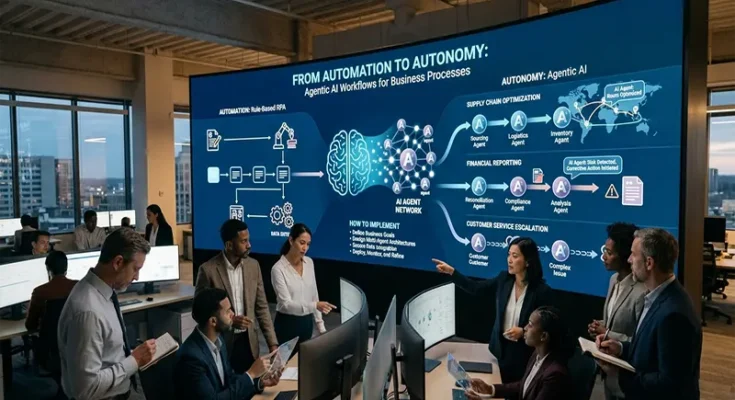
From Automation to Autonomy: How to Implement Agentic AI Workflows for Business Process Automation
For years, businesses have relied on Robotic Process Automation (RPA) to handle repetitive, rule-based tasks. While effective for simple data entry, these tools are inherently brittle—they break if the process changes even slightly. The next frontier in digital transformation is Agentic AI. Unlike static automation, agentic systems are proactive, goal-oriented, and capable of reasoning through complex, multi-step workflows. By transitioning from rigid task-execution to autonomous goal-seeking, enterprises can finally unlock the true promise of intelligent operations.
The Core Architecture of Agentic Workflows
The shift to agentic systems requires moving away from the “if-this-then-that” logic of traditional automation toward a flexible, cognitive architecture. A robust agentic workflow is built on three foundational pillars:
- Planning and Reasoning: At the heart of an agent is a Large Language Model (LLM) that functions as a “brain.” When given a high-level goal, the agent decomposes it into manageable sub-tasks. It doesn’t just execute a