In the current professional landscape, the traditional tether to a desk has all but vanished. Today’s workforce—comprising hybrid teams, frequent travelers, and executives on the go—requires a device that functions as a high-performance workstation while remaining nearly invisible in a carry-on. By 2026, the market has shifted away from bulky “desktop replacements.” The new gold standard is defined by three pillars: ultra-portability, AI-accelerated multitasking, and, most importantly, true multi-shift battery endurance.
The New Efficiency Standards
For years, the “all-day” battery claim was a myth fueled by optimistic lab testing. Today, that has changed thanks to a fundamental shift in silicon architecture. The rise of ARM-based platforms, such as Qualcomm’s Snapdragon X Elite and X2 series, alongside ultra-efficient x86 advancements like Intel’s Core Ultra Series 3 and AMD’s Ryzen AI, has closed the performance-per-watt gap.
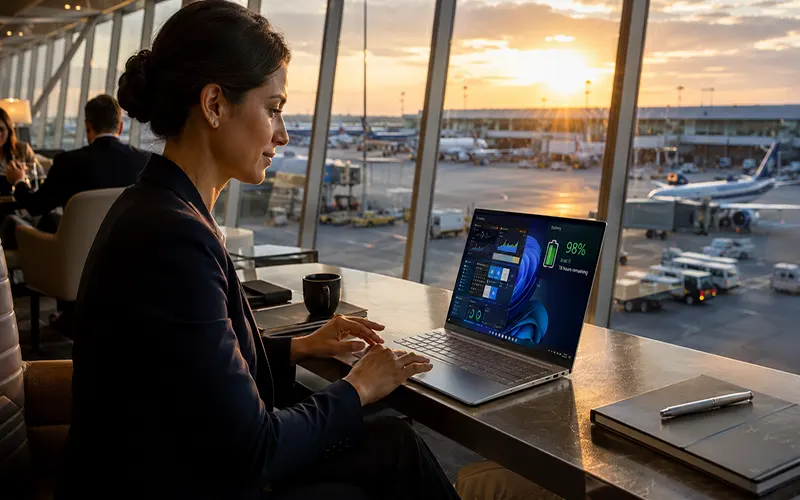
We have moved beyond the 8-hour workday expectation. Modern business laptops now reliably deliver 18 to 24 hours of real-world mixed usage. These chips integrate the CPU, GPU, and NPU (Neural Processing Unit) onto a single System on Chip (SoC), drastically reducing power leakage and heat. For the mobile professional, this means you can survive a transatlantic flight or a full day of back-to-back client meetings without reaching for a charger, even while utilizing demanding AI-enhanced video conferencing tools.
Hardware Essentials for Mobility
When procuring or purchasing a machine for a mobile workflow, certain hardware specifications are non-negotiable in 2026:
- Weight & Material: A true road warrior machine should hover under the 1.2kg (2.6 lbs) mark. Leading manufacturers have moved beyond simple plastics, favoring advanced magnesium-aluminum alloys or Ceraluminum—a high-tech ceramic-metal composite that offers superior structural rigidity and a premium, smudge-resistant finish without adding unnecessary weight.
- Display Technology: The choice between OLED and IPS is no longer just about color; it’s about power and comfort. Modern 3K OLED panels are increasingly efficient, offering “low blue light” hardware certifications that reduce eye fatigue during long sessions. Look for variable refresh rates (30Hz–120Hz), which allow the screen to throttle power when displaying static documents.
- Connectivity: Efficiency is hampered by outdated peripherals. Wi-Fi 7 is now the baseline, offering Multi-Link Operation (MLO) that prevents connection drops in congested office or airport environments. Thunderbolt 4/5 ensures that when you do sit at a desk, a single cable handles docking, high-speed data, and rapid charging.
Top Contenders for 2026
While the market is crowded, three archetypes stand out for their specific approach to the mobile professional’s needs:
- The Productivity King: Lenovo ThinkPad X1 Carbon Gen 13 (Aura Edition). For the professional who cannot compromise on typing feel or enterprise-grade reliability, the X1 Carbon remains the benchmark. With its sub-1kg weight, 19+ hour real-world battery life, and legendary keyboard, it remains the most trusted tool for C-suite and field-based operations.
- The Battery Champion: Acer Swift Go 14 (Snapdragon X). Powered by the efficiency of the Snapdragon architecture, this device is built for the “always-on” user. It represents the best value-to-battery ratio, offering 20+ hours of endurance and a fanless, silent operation that is invaluable during client presentations and quiet workspaces.
- The Design & Display Icon: ASUS Zenbook S 14/S16. These machines demonstrate the peak of 2026 design. Featuring Ceraluminum chassis and stunning 3K OLED displays, they offer up to 24 hours of battery life while maintaining a razor-thin profile. They are the clear choice for creative professionals and consultants who need a display that is as impressive as their output.
The Buying Decision
Choosing the right machine requires matching your workflow to the chip architecture. If your day-to-day relies heavily on legacy x86 software or specialized enterprise suites, the latest Intel Core Ultra Series 3 or AMD Ryzen AI platforms will offer the best compatibility with no performance trade-offs. If your work is primarily web-based, cloud-centric, or focused on AI-accelerated productivity, the Snapdragon-based ARM laptops offer the best battery efficiency and silent operation.
Comparison Table: 2026 Ultraportable Leaders
| Model | Approx. Weight | Est. Battery Life | Best Use Case |
| ThinkPad X1 Carbon (Gen 13) | ~0.98 kg | 19+ hours | Corporate standard, typing heavy work |
| Acer Swift Go 14 | ~1.32 kg | 20+ hours | Budget-conscious mobile productivity |
| ASUS Zenbook S 14/16 | 1.2–1.5 kg | 23+ hours | Creative/design, media-rich tasks |