
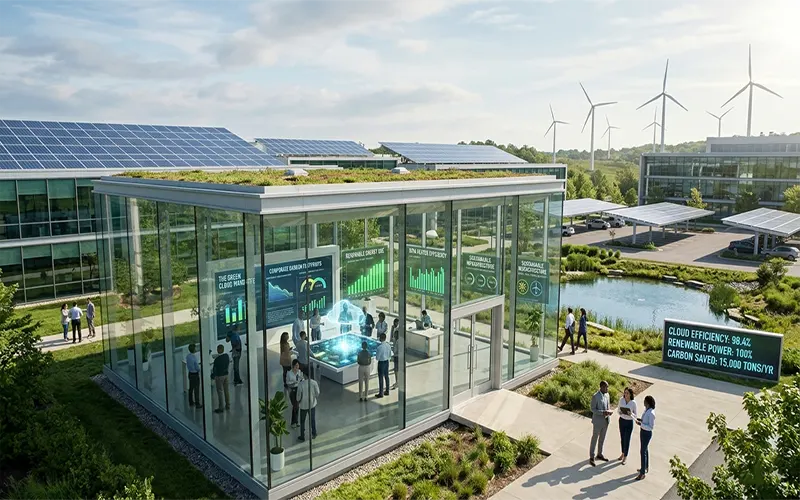
In 2026, the transition to the cloud is no longer just a driver of agility and cost-efficiency; it has become a core lever for corporate environmental, social, and governance (ESG) strategy. As digital operations expand, the “Green Cloud” has shifted from a sustainability buzzword to a board-level business requirement. While traditional on-premises data centers are often constrained by legacy hardware and inefficient cooling, hyperscale cloud environments offer a path to significantly lower carbon intensity per unit of compute.
The Four Pillars of Sustainable Cloud
Reducing IT-related carbon requires a multi-layered approach that moves beyond simple migration. Organizations are now focusing on four strategic pillars:
- Energy Efficiency: Hyperscale data centers utilize advanced infrastructure, such as liquid cooling and AI-driven power management, to achieve a Power Usage Effectiveness (PUE) ratio approaching 1.0. By consolidating workloads into these optimized environments, companies benefit from economies of scale that are impossible to replicate in private server rooms.
- Renewable Energy Procurement: Top-tier cloud providers are among the world’s largest purchasers of wind, solar, and hydroelectric power. Migrating to these providers allows enterprises to inherently align their IT operations with the global transition toward renewable energy.
- Circular Hardware Practices: Sustainability extends to the hardware lifecycle. Modern strategies emphasize extending the useful life of server components through proactive maintenance, sourcing refurbished equipment where appropriate, and ensuring responsible IT Asset Disposition (ITAD) to prevent e-waste.
- Carbon-Aware Software Engineering: This represents the next frontier of efficiency. It involves “temporal shifting”—scheduling batch jobs or model training when the grid is cleanest (highest renewable availability)—and “spatial shifting,” which involves placing workloads in geographic regions with the lowest carbon intensity.
Strategic Implementation & Metrics
To move from abstract goals to measurable reduction, organizations must operationalize sustainability within their DevOps and FinOps workflows.
- Resource Optimization: The most sustainable server is the one that isn’t running. Organizations are aggressively eliminating “zombie servers” and over-provisioned instances. By leveraging serverless architectures and containerized deployments (e.g., Kubernetes), businesses can ensure that hardware utilization is high, drastically reducing the energy wasted on idle CPU cycles.
- Data Minimalization: Unchecked storage growth—often called “dark data”—is a major contributor to power consumption. Implementing rigorous data lifecycle policies ensures that storage energy is spent only on assets that provide tangible business value.
- Key Performance Indicators (KPIs): Success in 2026 is measured by metrics that go beyond simple utility bills. Organizations now track:
- PUE (Power Usage Effectiveness): The ratio of total energy to IT-specific energy.
- CUE (Carbon Usage Effectiveness): The carbon emissions generated per unit of IT equipment energy.
- Capacity per Watt: A measure of how much computational work is achieved per unit of power consumed.
Governance & Reporting
In the current regulatory landscape, transparency is non-negotiable. Leading enterprises are aligning their cloud reporting with global standards like the Greenhouse Gas (GHG) Protocol and the Green Software Foundation’s Software Carbon Intensity (SCI) specification. By integrating carbon-monitoring tools (such as native cloud dashboards or open-source solutions like the Cloud Carbon Footprint tool) into the CI/CD pipeline, teams can treat carbon as a “first-class citizen” alongside cost and performance. This data-driven approach prevents greenwashing and provides the audit-ready evidence required by investors and regulators.
Sustainable cloud infrastructure is ultimately a competitive advantage. It aligns IT operations with broader corporate sustainability goals while simultaneously driving down operational costs through improved resource utilization. By making data the foundation of every architectural decision, businesses can ensure that their digital growth is not just rapid, but responsible.
Sustainability Impact Matrix
| Metric | Traditional On-Premise Infrastructure | Sustainable Cloud Infrastructure |
| Energy Intensity | High (Inefficient overhead, low utilization) | Low (Optimized hyperscale, high utilization) |
| Carbon Tracking | Difficult/Manual | Automated/Real-time (Native tools) |
| Operational Waste | High (Idle resources, cooling loss) | Minimal (On-demand scaling, liquid cooling) |
| Lifecycle Management | Often linear (Replace every 3–5 years) | Circular (Refurbished/Recycled/Optimized) |