

Finding the Balance: Healthy Computer Screen Time Limits for Elementary Students

Finding the Balance: Healthy Computer Screen Time Limits for Elementary Students

In the modern digital landscape, screens have become an inseparable part of childhood. From interactive classroom whiteboards and AI-enhanced learning apps to weekend video calls with distant family, technology is woven into the fabric of daily life. For parents of elementary school students (ages 6–11), this reality often brings a lingering sense of anxiety: Are they spending too much time on devices? Is this affecting their development?

The goal for modern parenting is no longer “screen abstinence,” which is increasingly impractical, but rather “digital intentionality.” By reframing our relationship with technology from a default activity to a purposeful tool, we can help our children navigate the digital world without sacrificing the essential experiences of childhood.

Understanding Developmental Needs

The elementary years are a critical window for cognitive, physical, and social development. During this time, the brain is highly plastic, forming the neural pathways that will support lifelong learning. Two foundational …

Finding the Balance: Healthy Computer Screen Time Limits for Elementary Students Read More
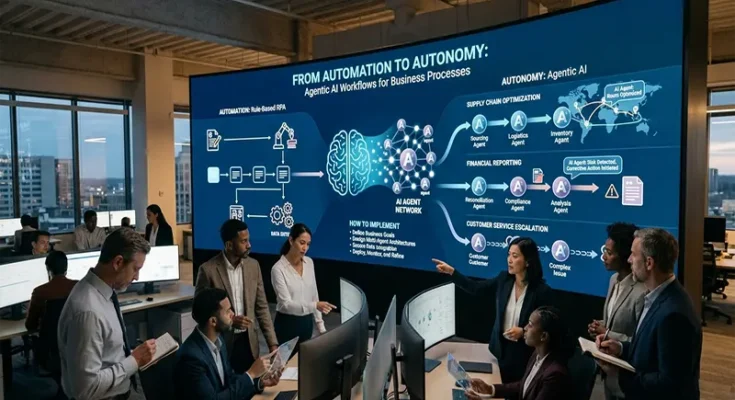

From Automation to Autonomy: How to Implement Agentic AI Workflows for Business Process Automation

From Automation to Autonomy: How to Implement Agentic AI Workflows for Business Process Automation

For years, businesses have relied on Robotic Process Automation (RPA) to handle repetitive, rule-based tasks. While effective for simple data entry, these tools are inherently brittle—they break if the process changes even slightly. The next frontier in digital transformation is Agentic AI. Unlike static automation, agentic systems are proactive, goal-oriented, and capable of reasoning through complex, multi-step workflows. By transitioning from rigid task-execution to autonomous goal-seeking, enterprises can finally unlock the true promise of intelligent operations.

The Core Architecture of Agentic Workflows

The shift to agentic systems requires moving away from the “if-this-then-that” logic of traditional automation toward a flexible, cognitive architecture. A robust agentic workflow is built on three foundational pillars:

  • Planning and Reasoning: At the heart of an agent is a Large Language Model (LLM) that functions as a “brain.” When given a high-level goal, the agent decomposes it into manageable sub-tasks. It doesn’t just execute a
From Automation to Autonomy: How to Implement Agentic AI Workflows for Business Process Automation Read More
The Future of the Classroom: Benefits of AI-Powered Personalized Learning Platforms

The Future of the Classroom: Benefits of AI-Powered Personalized Learning Platforms

The traditional “one-size-fits-all” model of education—where a single teacher delivers the same lesson to thirty students at the same pace—has long struggled to meet the diverse needs of every learner. Today, that paradigm is shifting. As artificial intelligence (AI) integrates into K-12 classrooms, it is ushering in a new era of “hyper-learning,” where education is tailored to the individual pace, interests, and proficiency levels of each student. By moving away from static curricula and toward adaptive, AI-driven environments, schools are discovering a more inclusive and effective path to academic success.

Adaptive Learning Paths: Education at Every Pace

The most significant shift AI brings to the classroom is the ability to create adaptive learning pathways. Traditional textbooks are linear, but AI-powered platforms are dynamic. By analyzing student performance in real-time, these systems can adjust the difficulty level of content instantaneously. If a student grasps a math concept quickly, the AI accelerates …

The Future of the Classroom: Benefits of AI-Powered Personalized Learning Platforms Read More
Are There Risks in DIY Approaches to CMMC Compliance Requirements

Are There Risks in DIY Approaches to CMMC Compliance Requirements

Trying to tackle CMMC compliance requirements without professional help seems appealing, especially for companies looking to cut costs. However, what looks straightforward can quickly spiral into unexpected trouble. Here’s a fresh look at the less obvious risks behind attempting DIY compliance.

Misinterpretation of Controls Leads to Critical Vulnerabilities

Misreading or misunderstanding CMMC level 1 requirements can open the door to major security vulnerabilities. Simple language in the guidelines can mask the complexity of proper implementation. Companies often think they’re doing everything right until a security breach shows otherwise, leaving them scrambling to fix overlooked gaps.

Even minor mistakes interpreting the CMMC level 2 requirements can escalate into serious risks. Controls might seem straightforward, but their real-world application is trickier. Without expert guidance, it’s easy to assume a control has been met when, in fact, the organization remains exposed to threats, leading to embarrassing compliance failures and damaging vulnerabilities.

Documentation Errors

Are There Risks in DIY Approaches to CMMC Compliance Requirements Read More
Countering Threats in the Digital Age: The Vital Role of AI in Cyber ​​Threat Detection and Analysis

Countering Threats in the Digital Age: The Vital Role of AI in Cyber ​​Threat Detection and Analysis

Amidst massive digital transformation, Indonesia’s cyber threat landscape is evolving at an unprecedented pace. Cyberattacks are now more sophisticated, automated, and designed to evade conventional defenses.1This is where AI tools for cybersecurity threat detection and analysis become vital. Artificial intelligence (AI) is no longer just an add-on feature, but a revolutionary vanguard in maintaining cybersecurity.

AI enables organizations to shift from a reactive security posture (responding to attacks after they occur) to a proactive one (predicting and preventing attacks before they occur). With the ability to process and analyze massive amounts of data, AI provides insights that human teams alone would never have been able to obtain.

Limitations of Conventional Cyber ​​Security

Before the widespread adoption of AI, cybersecurity teams face several significant challenges:

  1. Enormous Volume of Data: Modern security systems generate millions of logs and alerts every day. Manually analyzing this data is an impossible task and
Countering Threats in the Digital Age: The Vital Role of AI in Cyber ​​Threat Detection and Analysis Read More