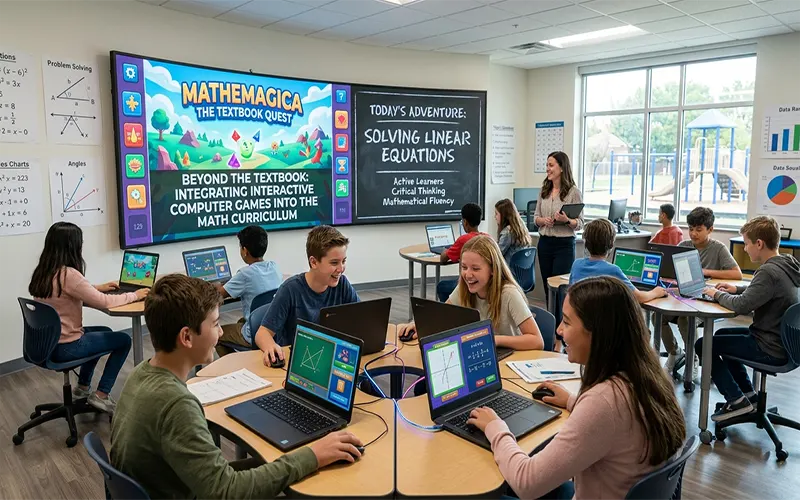
Middle school is a pivotal junction for mathematical development. It is the stage where students move from concrete arithmetic to the more abstract realms of algebra, geometry, and probability. Unfortunately, this is also the period where “math anxiety” often takes root, as the curriculum becomes less intuitive and the stakes feel higher. The challenge for educators is to maintain engagement during these formative years. Increasingly, the solution is being found in an unlikely place: the interactive computer game.
By treating games not as a “reward” for finished work, but as a core instructional tool, teachers can foster a sense of “productive struggle”—the sweet spot where students are challenged enough to be engaged, but supported enough to persevere.
The Pedagogy of Play
Why do interactive games succeed where traditional lectures sometimes fail? The secret lies in the cognitive science of play.
- The Flow State: Games are masterfully designed to keep players in a “flow state.” By constantly adjusting difficulty based on performance, they ensure that students are neither bored by tasks that are too easy nor overwhelmed by content that is too difficult.
- Immediate Feedback Loops: In a traditional classroom, a student might complete a worksheet and wait 24 hours to see which problems were solved incorrectly. In a digital game, feedback is instantaneous. If a student makes a mistake, the game signals them immediately, allowing for “real-time remediation.” This prevents the practice of bad habits and turns every mistake into a learning opportunity.
- Visualizing Abstractions: Middle school math often deals with concepts that are hard to visualize, such as coordinate planes, ratios, or algebraic variables. Interactive games turn these abstractions into concrete, manipulatable objects. When a student uses an algebraic game to balance a virtual equation, they are engaging with the logic of the math physically, building a stronger conceptual foundation.
Curriculum Integration Strategies
Integrating games effectively requires more than just letting students loose on a tablet. Here are three strategies for seamless implementation:
- The “Warm-Up” Method: Utilize 10-minute game sessions at the beginning of a class to build skill fluency. Whether it is a rapid-fire fractions game or a logic puzzle, these sessions prime the brain for the more complex work that follows, acting as a “mental stretching” exercise.
- Collaborative Problem Solving: Shift from individual play to collaborative play. Assign students to work in pairs on strategy-based games where they must explain their mathematical reasoning to their partner to progress. This forces students to use “math talk,” a critical skill for deepening conceptual understanding.
- Assessment Integration: Modern game-based platforms provide teachers with robust dashboards. These “game analytics” offer insights into individual student progress, highlighting exactly where a student is struggling. Teachers can then use this data to group students for targeted, small-group instruction.
Overcoming Implementation Hurdles
Some educators and parents remain skeptical, worrying that games are a distraction from “serious” learning. To address this, schools should focus on research-based titles that prioritize logic, strategy, and simulation over mindless clicking. Furthermore, screen time concerns can be mitigated by ensuring that game-based learning is a deliberate, time-boxed portion of a broader, blended curriculum that includes pencil-and-paper practice, discussion, and real-world application.
Future Outlook
As we move through 2026, the potential for game-based learning is expanding. We are beginning to see the integration of generative AI within these games, allowing them to create adaptive, unique problem scenarios that evolve in difficulty based on an individual student’s performance. By embracing these tools, educators can provide a more personalized, motivating, and agency-driven experience. When we make math interactive, we aren’t just teaching a subject; we are building students who see themselves as capable problem-solvers.
Game-Based Learning Framework
| Math Topic | Gaming Mechanic | Educational Benefit |
| Ratios & Proportions | Simulation/Economy | Scaling resources, balancing budgets |
| Fractions & Decimals | Puzzle/Platformer | Visualizing parts of a whole, precision |
| Algebraic Equations | Strategy/Logic | Balancing variables, isolating unknowns |
| Geometry | Construction/Sandbox | Spatial reasoning, spatial manipulation |
| Probability & Data | Adventure/Randomization | Predicting outcomes, analyzing trends |